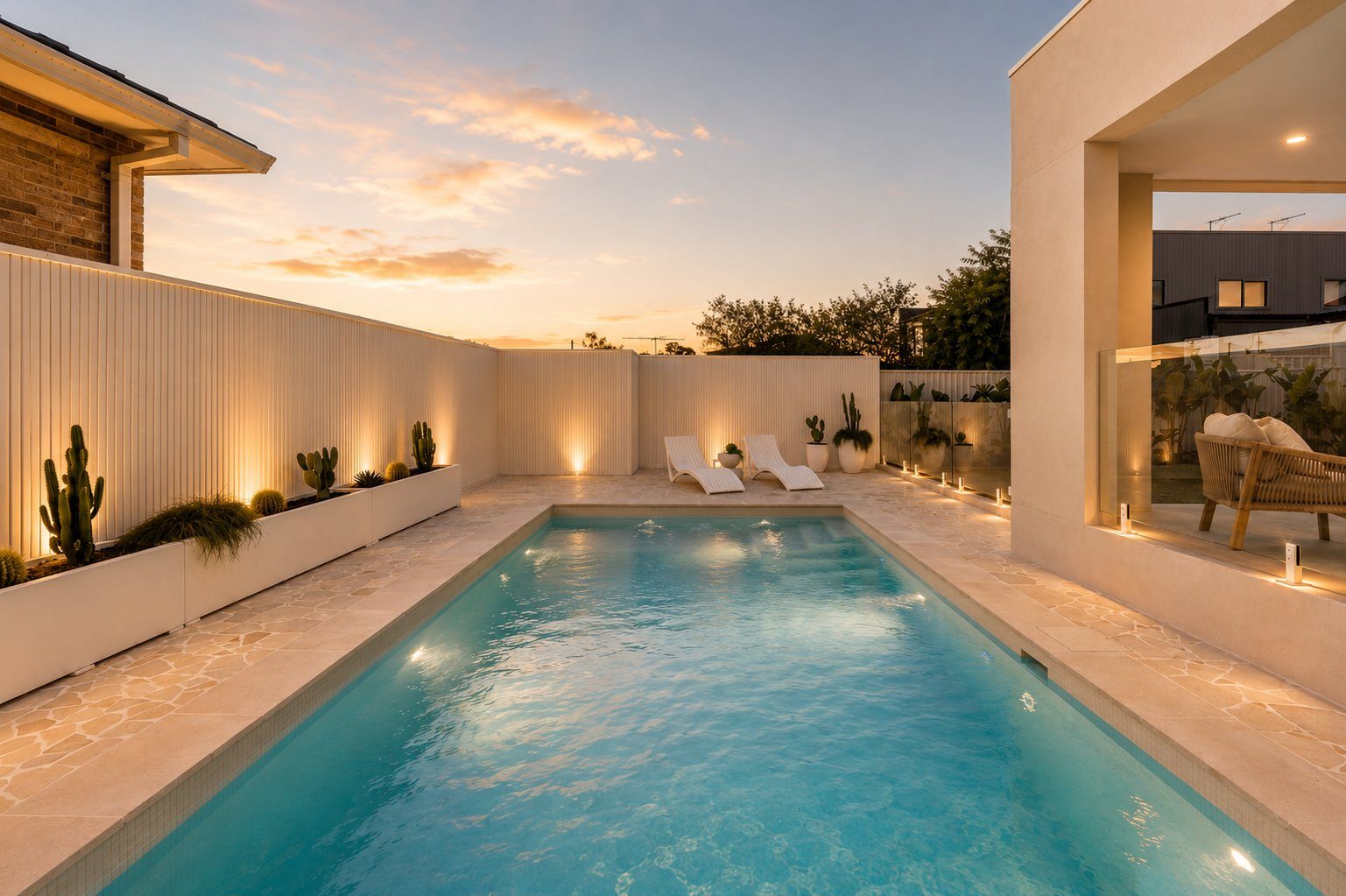
Sydney's inner-city blocks have always been narrow. New subdivisions are getting tighter. Yet clients still — rightly — want pools.
The good news: with the right design approach, beautiful pools can be built on lots that 99% of pool builders would tell you are "too tight". We do it regularly. Here are six strategies that consistently work.
The principles
On a narrow block, three things matter most: (1) work with the geometry, don't fight it; (2) integrate pool, fence, paving and planting as one design problem; (3) make the pool the architectural focus, not an afterthought.
Strategy 1: The plunge pool
The most obvious strategy and often the right one. A plunge pool is typically 4-6m long and 2-3m wide — small enough to fit in a courtyard, terrace, or compact backyard.
Plunge pools are surprisingly versatile. You can:
- Swim against jets (swim-spa fitouts give you "endless swimming" in a tiny footprint)
- Add a spa heater and use it as a hot tub in winter
- Run it cold (8-12°C) as a recovery plunge
- Use it as a beautiful water feature year-round
For an inner-city terrace or warehouse conversion with a 5m x 8m courtyard, a plunge pool is often the perfect answer. Cost: typically $90,000-$180,000 depending on finishes.
Strategy 2: The boundary lap pool
If you have length but no width — a classic Sydney terrace or duplex configuration with 2-3m of side passage — a long, narrow lap pool along the boundary can be the answer.
Typical dimensions: 1.5m-2.5m wide, 12-18m long. Tucked along the side fence, the pool becomes a linear feature that draws the eye through the space and makes the property feel longer.
Practical considerations:
- Setbacks from boundaries vary by council — typically 1m minimum, sometimes 1.5m
- The narrow width means proper swim stroke is possible but turns are tight
- Glass pool fencing along the long axis keeps sight lines open
- Lighting and planting along the boundary becomes critical to the experience
Strategy 3: Stretch and shape
On many narrow blocks, the "obvious" rectangular pool placement wastes space. Sometimes a non-rectangular shape — L-shape, T-shape, dog-leg — uses awkward site geometry better.
Example: a 7m wide x 18m long backyard with a side return at the end. A 5m x 4m rectangular pool at the back wastes the side return. An L-shaped pool wrapping the corner uses that "wasted" space and creates a more interesting form.
This is where concrete construction really pays off — fibreglass can't do these shapes.
Strategy 4: Pool as architectural element
On a small site, the pool can't be a hidden backyard amenity. It needs to be a deliberate architectural feature visible from the main living spaces of the home.
Strategies we use:
- Floor-to-ceiling glazing onto the pool — pool becomes part of the living room
- Reflective dark interiors (charcoal, deep blue glass mosaic) — turns the pool into a still water feature when not in use
- Single visual element — pool, paving, and fence read as one composition, not three things
- Lighting design — feature lighting in and around the pool makes it a nighttime focal point
The mindset shift: stop hiding the pool. Make it the star of the architecture.
Strategy 5: Above-ground or partially raised
On sloping sites or where excavation is severely constrained, a partially or fully raised pool can be a solution. Concrete pools can be built above grade as long as the engineering accommodates the water pressure.
Advantages:
- Reduces excavation cost (often huge on rock-bound Sydney sites)
- Creates a built-in seating wall
- Allows the pool to project into views or align with finished floor levels
- Can be integrated into terrace and deck structures
Worth exploring particularly on sandstone-bound sites in the Eastern Suburbs and Lower North Shore where rock excavation costs can blow budgets.
Strategy 6: Combine with a spa
If the brief includes both pool and spa but the site doesn't support both as separate elements, integrated spa-pool combinations are extremely efficient.
A 7m pool with a 2.5m integrated spa (raised slightly, with a wet-edge spillover into the pool) occupies the same footprint as a small standalone pool but delivers both functions.
Many of our most successful narrow-block projects are spa-pool combinations. The visual richness of the spa overflow gives the project significant design presence in a small footprint.
What we'd avoid on a narrow site
Some things just don't work on tight blocks:
- Infinity edges — usually need a view to disappear into; rarely available on inner-city sites
- Beach entries — eat too much length
- Large equipment sheds — try to integrate equipment under decks or in side passages
- Fenced-off pool areas — better to fence the whole rear yard than create a smaller pool enclosure
- Excessive paving — the pool itself should be the dominant element
Approvals on narrow sites
One last thing worth flagging: pools on narrow blocks more often require DA (Development Application) rather than CDC (Complying Development Certificate). The standard CDC requires meeting setback, height, and overlooking criteria that narrow blocks sometimes can't satisfy.
A DA isn't a disaster — it just adds 6-10 weeks to the approvals timeline and slightly higher fees. Plan for it.
Narrow block worth solving?
We love a constrained site. Send us your dimensions and let's see what's possible.
Get in touchUpdated April 2026. The team at We Build Pools & Spas designs and builds across Sydney metro — many of our most rewarding projects are on the tightest sites.